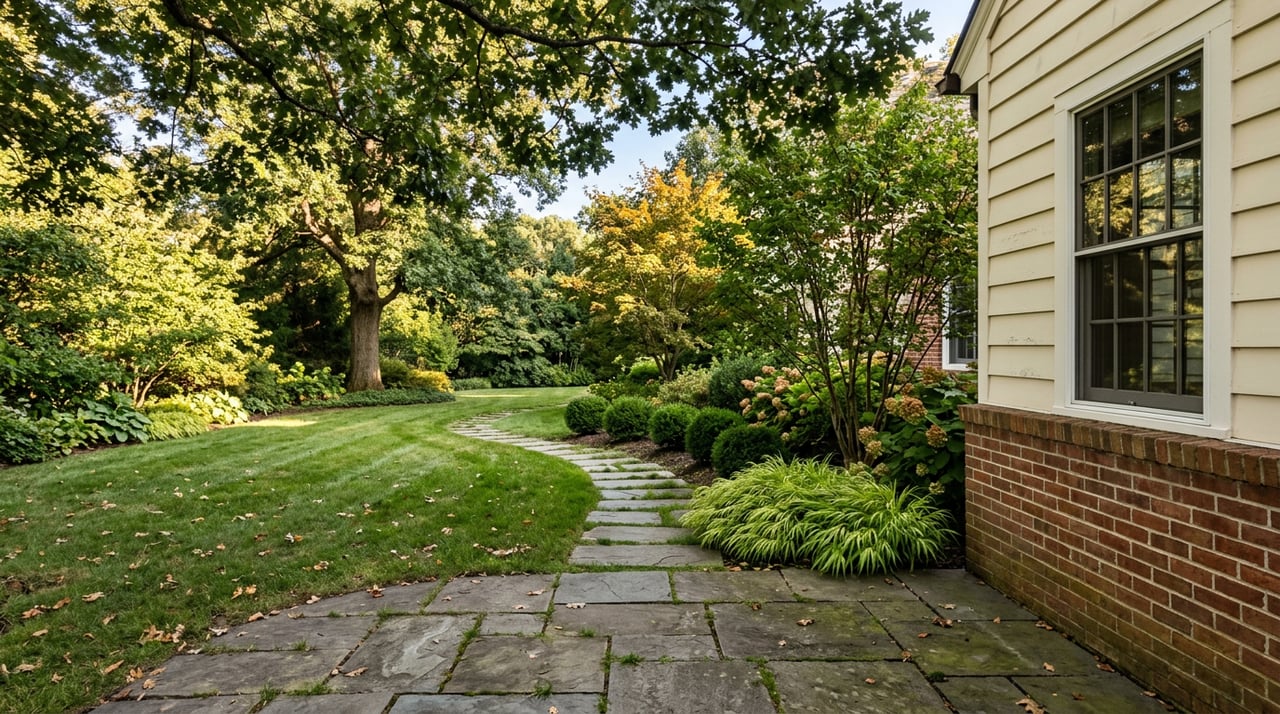
Ladue reads, from the outside, like a city defined by open space. Wide lawns, mature tree canopies, a scattering of country clubs, and three named parks tucked between the subdivisions. What that impression leaves out is that those green spaces have never actually spoken to each other. Rodes Park sits at the corner of Ladue Road and Warson. Deer Creek Preserve sits nearly a mile southwest on South 40 Drive. Getting from one to the other on foot has meant walking the shoulder of a road built for cars, not pedestrians, because Ladue was laid out that way from the start: generous lots, minimal sidewalks, and a road network that assumed everyone would drive.
That assumption is finally being corrected, piece by piece, and this year is the one where the pieces start to show. The city has a funded, engineered plan to physically link its parks for the first time. It is not finished. Construction is not scheduled until 2027. But the design work happening right now, and the small business decisions already being made along the route, tell you something the postcard version of Ladue never mentions: this is a city that is only now building the connective tissue between the green spaces it has had for decades.
Rodes Park exists because of a single decision by Boyle Rodes, Ladue's first mayor, who bought a parcel of land next to his own house specifically to keep a gas station from being built there. That is the entire origin story. It was never planned as part of a network. It was one man's block on one project, and the Garden Club of St. Louis has spent years since planting daffodils there and, more recently, a dogwood tree in memory of members the club has lost. It is a small park with a personal history, not a civic system.
Deer Creek Preserve has an even stranger past. The 14-acre site on South 40 Drive was purchased from Ameren in 1988 and spent nearly three decades as a mulch processing site for the city's leaf and brush program. That program got discontinued in 2017, not because anyone objected to it but because only 11 percent of residents were actually using it, and the cost of running it no longer made sense. The city's parks page walks through what happened next: a 2019 planning grant, a master plan the council approved that September, and a Phase 2 concept plan that only came together in 2025. Somewhere in the middle of that, from 2021 to 2023, the site got torn up again by the Metropolitan Sewer District's Deer Creek Sanitary Sewer replacement project, which runs straight through the property.
Neither park was designed with the other in mind. That is the part worth sitting with. Ladue's green space has always grown by accident and by individual civic effort, not by a plan that treats parks as points on a connected map.
The city has been working on the sidewalk half of this problem for years, in phases that most residents only notice when the orange cones show up. The Clayton Road ADA sidewalk project alone has moved in stages: the business district between I-64 and Conway Road finished in the summer of 2019, Warson to Eversdale finished the following spring, and Eversdale to Lindbergh wrapped in the spring of 2021. A sixth phase, running from Lay Road to Price Road, is now in design, with construction expected once that work concludes. This is not a single ribbon-cutting. It is a decade-long retrofit of a road that was never built to be walked.
That context matters for what comes next, because the same patience shows up in the project that finally connects Ladue's two main parks to each other.
The South 40 Drive Shared-Use Path Extension is the project to watch, and it is further along than most people realize. The city secured Transportation Alternative Program funding for a path extension that will connect Deer Creek Preserve east to the Trails End Subdivision and west to the intersection of Clayton Road and South 40 Drive, with pedestrian signal upgrades at that intersection built into the same scope. The city council approved the engineering contract with Horner and Shifrin in October 2024. Design work has been underway through 2025, right-of-way acquisition is scheduled for 2026, and construction is set for 2027.
Here is what that timeline actually means for someone who lives near it. Right now, walking from the Trails End Subdivision to Deer Creek Preserve, or from the preserve up to the Clayton Road shopping strip, means sharing the shoulder with traffic. Once the path is built, it will be one of the only off-street links in the city that lets a resident move between a residential pocket and a green space without touching Clayton Road at all. That is a small thing to build and a genuinely different thing to have.
It is worth being honest about where this stands today. The path is funded, designed, and dated. It is not open. A resident checking the calendar in August 2026 is looking at a construction window still a year out, not a ribbon to walk across this fall.
While the bigger path project works through design and right-of-way, Rodes Park is getting attention on its own timeline. The Garden Club of St. Louis has confirmed that the city, working with both the Garden Club and the Ladue Garden Club, is now planning longer-term improvements to the park: a bridge, new paths, benches, and native plantings, layered on top of the daffodil beds the clubs have tended for years. Rodes Creek, the small stream that runs through the park, was formally named in 2010 as part of a regional project to give St. Louis area waterways their historic names back. The stream had been unnamed on paper even though the neighborhood around it had used it, informally, for generations.
That is the pattern across all of this. Ladue's green spaces have been quietly maintained and quietly improved for years by people who cared about one specific parcel. What is changing now is that the city is starting to treat them as a system rather than a collection of separate favors.
The businesses along the route are not waiting for the concrete to get poured. Companion, the bakery and café at 9781 Clayton Road, anchors the block with a sprawling patio and a menu built around daily-rotating soups, fresh bread, and sandwiches, the kind of place regulars stop into on foot rather than drive across town for. Ladue Taco, its affiliated restaurant tucked into the alley directly behind Companion, keeps evening-only hours and serves tacos to go, including a crisp breaded mahi-mahi, alongside margaritas sized from a single serving up to a full gallon. It is a setup built for people already on foot in that stretch, not for a destination drive.
The clearer signal of where operators think foot traffic is headed is Playa Bowls. When Brittany and Jeff Ciaramita, a St. Louis cardiologist and his wife, announced their five-unit development deal to bring the fruit bowl and smoothie chain to the region in February, the press release named Clayton as the target for their first location, opening this fall. Window signage installed this summer told a different story: the actual first Missouri Playa Bowls is landing at 8853-Q Ladue Road, just west of Clayton, opening this August. The 1,200-square-foot storefront most recently held JARS by Fabio Viviani, a celebrity chef dessert concept that closed earlier this year after a 19-month run, and before that it was a MaggieMoo's. A national chain redirecting its first-in-state opening from the county seat to a stretch of Ladue Road most people drive past without a second look says something about how operators are reading foot traffic on this specific corridor. Schnucks Ladue, at 8867 Ladue Road, remains the anchor that keeps the whole strip functioning as an errand loop rather than a destination.
None of these businesses are waiting for the shared-use path to open. They are positioning now for a corridor that is about to get a lot easier to walk.
The honest read on Ladue's green space is that it was never designed as a network. It was built one parcel at a time, by a mayor blocking a gas station, by a mulch program nobody used anymore, by a garden club that kept showing up to plant daffodils regardless of what the city was doing with the property next door. What is happening now, slowly and on a schedule measured in years rather than months, is the first real attempt to connect those separate decisions into something a resident can actually walk end to end.
If you already call Ladue home, this is the kind of change worth watching over the next two construction seasons, not because it will transform daily life overnight, but because it will quietly answer a question every resident has asked at some point while standing on the shoulder of South 40 Drive: why can't I just walk there.
If you are thinking about what comes next for your own property here, whether that means understanding how a changing corridor affects value or simply wanting a clear-eyed read on the neighborhood from people who track it closely, the team at Medelberg Savage Group is glad to talk it through. Get Your Free Home Valuation whenever you are ready to see where your home stands today.
MEDELBERG SAVAGE GROUP
16505 WILD HORSE CREEK RD
CHESTERFIELD MO 63017
Margie Medelberg
[email protected]
(314) 265-3888
Clay Savage
[email protected]
(636) 399-8237
Keremie Kiddy
[email protected]
(314) 779-8268
Terri Rea
[email protected]
(314) 374-5128
MEDELBERG SAVAGE GROUP
16505 WILD HORSE CREEK RD
CHESTERFIELD MO 63017
Margie Medelberg
[email protected]
(314) 265-3888
Clay Savage
[email protected]
(636) 399-8237
Keremie Kiddy
[email protected]
(314) 779-8268
Terri Rea
[email protected]
(314) 374-5128